Your Rights to Protest or Demonstrate

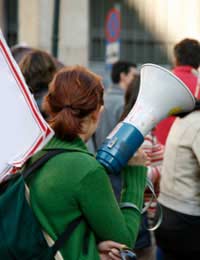
You don’t need to look too far back in your memory, or the archives of the newspapers, to see that many violent protests (such as the Poll Tax Riots) make the headlines for entirely the wrong reasons. The right to protest peacefully is a fundamental part of our society. We tend to forget that many of the human rights we cherish today are a direct result of protests by ordinary people who were prepared to go onto the streets to make their feelings known.
Peaceful Protests
It is a sad fact that many of the groups that make a point of ensuring that their protests are peaceful tend not to hit the headlines as much as they deserve. However, they have still been instrumental in bringing about sweeping changes to the UK law and ensuring that we never lose any part of the freedom we have.The most famous in my mind is the Suffragette Movement in England during the Victorian period. We cannot forget that they brought about the right for women to vote – without them we may still be living in a patriarchal society.
Pressure groups such as Liberty, Amnesty International and the British Institute of Human Rights have campaigned peacefully to ensure that the human rights we now enjoy made it onto the law books. Some groups have even managed to erase large parts of the debt placed on third world countries in a bid to ease suffering. So we can see that home-grown peaceful protest groups are instrumental in bringing about the recognition of international human rights and international freedom.
The Human Rights Act
1998 was an important year for the development of our human rights; this is due to the completion and acceptance into our law of The Human Rights Act 1998. The included a specific right to engage in peaceful protest or ‘non-violent direct action’.Essentially the Act means that the Government, or any public authority, cannot stop you from organising or taking part in a public protest, provided that the there is no harm to other people or property. This includes the person, group or thing you are protesting against, the Police or any rival protestors.
What is Non-Violent Direct Action?
This is any protest that gets your point across without descending into a riot of violence, blood-shed and mayhem. All protests get publicity but those that are carried on in a dignified manner tend to get the best attention from the media; and the greatest sympathy for your cause. For instance:- Truck-drivers organising, and getting authority for, a blockade to protest against fuel prices.
- You could organise a ‘sit-in’ – this is a protest where all of those involved sit on the floor in a prescribed location.
- You could get permission from your council to have a stall in your town centre, to tell people about the cause you are fighting for and gain valuable support.
In addition to this you could organise a petition to be sent to Parliament or arrange a protest march. Many of the things you could do will require the consent of your local authority to go ahead but they cannot withhold consent just because they don’t want you to speak out.
So the Police Can’t Stop Us?
Just because you have the freedom to protest does not mean that the Police cannot stop you, but again, there has to be a valid reason; such as the possibility of damage to property, serious public disorder or unacceptable disruption to the community around you.They can also stop you if they think you would become a target for terrorism or if they believe that what you are protesting for is against the larger public interest or could incite racial hatred.
In this way you have the freedom to protest but the community has the right to freedom from danger and discrimination while you are doing so. As long you make sure that all participants have the same peaceful event in mind then there is no reason that you should not make your feelings known.
- Human Rights...and Responsibilities
- Human Rights and Racial Equality
- Human Rights and Gender Equality
- Human Rights and Sexuality
- Human Rights and Transgender Issues
- Human Rights and Same Sex Marriages
- Right to Life: Not Just an Abortion Issue
- Personal Freedom: The Right to Behave How You Want
- Does a Child Need Human Rights?
- Your Rights as a Traveller
- Your Rights as an Immigrant

Re: Your Rights as a Suspect of a Crime
If a person has been arrested for an offence, and no accuser named, or only limited information as to the allegation so…
Re: UK Breaches of Human Rights Law
In 2018 social workers in Bournemouth deliberately neglected my concerns for the welfare of my daughter the lady in question…
Re: The UK's Equality and Human Rights Commission
How are you? I think London remains alert everywhere to human compassion. But I am feeling this less.…
Re: When a Country Breaches International Human Rights Law
My skibidi rizz was fanum taxed by Kai Cenat and that has brutally violated my human rights and…
Re: Human Rights and Adopted Children
TWO PASSPORTS FOR INTERNATIONAL ADOPTION I adopted two kids on international adoption and got my nationality after the…
Re: Human Rights and Medical Treatment
I am very concerned about my feelings of being gaslighted by just about everyone! I am a victim of the mesh implant I have…
Re: Do Airport Security Measures Breach My Human Rights?
There were no Muslims in the west and no problems. Then the leftists in power decided to bring…
Re: Can You Be Charged Without Caution?
So I was arrested from my home for something but I was taken to police station searched trousers took off me for there…
Re: Can You Be Charged Without Caution?
Can I be taken to court when no Interview was done and was on bail awaiting a new date to return for interview.
Re: Your Rights as a Suspect of a Crime
My partner was accused of a relationship with a student at her previous job. She was suspended and eventually left as…